
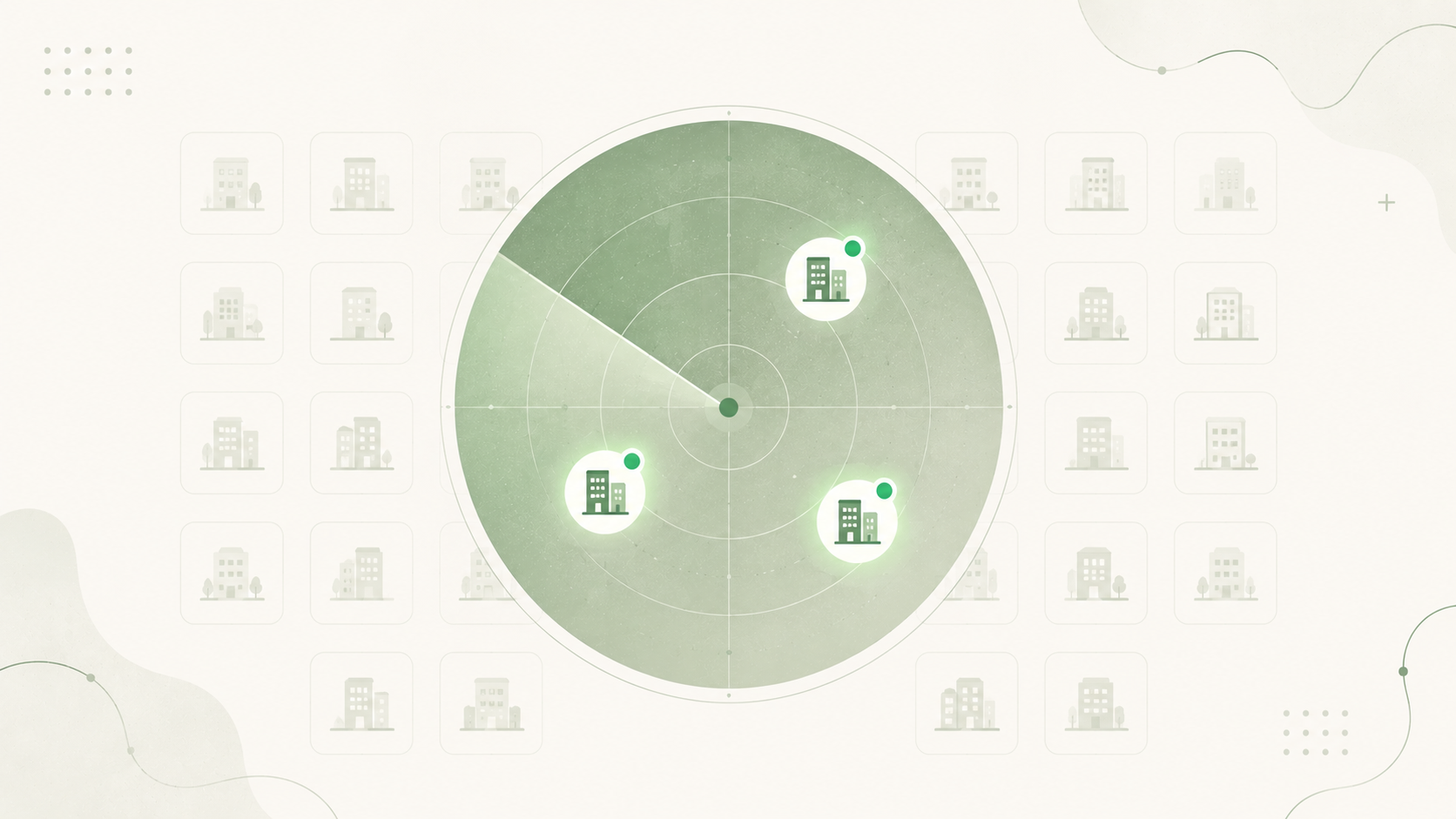
Jessica's team has a dashboard. It has been live for eight months, it has a health score on every account, and it is checked, by her own estimate, about once a week, usually on Monday morning, usually by her. It has never once told her which specific account to call first. It shows forty-five accounts in yellow and green, all the time, and a color that never changes stops meaning anything after the third week. The dashboard is not broken. It was just never built to be an early warning system. It was built to be a report.
The difference between the two is not visual. A report describes the current state of everything. A warning system tells you the two or three things that changed and require a decision, and it tells you before the decision window closes.
What makes something an early warning system, specifically
Three properties separate a warning system from a dashboard, and a tool can have a beautiful dashboard and still fail all three.
It surfaces change, not state. A dashboard shows you that an account is at 62 out of 100. A warning system tells you it dropped from 81 to 62 in nine days, which is the fact that actually demands action. The absolute number rarely matters as much as the direction and speed of the move.
It ranks, it does not list. Forty-five accounts in a table is not a warning, it is homework. A system worth checking daily narrows to the three or four accounts that need a human decision this week, ordered by urgency, so the CSM's first action every morning is obvious without interpretation.
It explains itself without being asked. A ranked list with no reasoning attached gets ignored by week three, because a CSM has no way to tell a real signal from noise without digging in manually, and digging in manually is the exact workload the system was supposed to remove.
Why most "health score" tools end up as reports instead
The failure mode is structural, not a bug. Most health scores are computed periodically, often weekly or on a batch schedule, from inputs a CS ops person configured months ago. Between refreshes, the number sits still even as the underlying account changes daily. A CSM who checks a static number that only moves once a week correctly learns, within a month, that checking it more often than that is a waste of time. The tool trains its own users to stop looking.
The four components an actual early warning system needs
Continuous input, not batch refresh
Usage, support tickets, call transcripts, and billing events need to feed the system as they happen, not on a weekly job. An account that goes quiet on a Tuesday should show up as changed by Wednesday, not the following Monday.
Trend-based scoring, not snapshot scoring
The system should weight the rate and direction of change higher than the current absolute value. A steep three-week decline from a high starting point is a stronger warning than a low, stable number that has not moved in two quarters.
A hard cap on what gets surfaced
Three to five accounts a day, not forty-five all the time. A CSM should be able to act on everything the system flags before lunch. A list too long to act on in full gets skimmed instead of worked, and skimmed warnings are functionally the same as no warnings.
A reason attached to every flag
Not a score alone, the specific ticket, call, or usage pattern that drove it. A CSM who sees "risk: 71" has to go investigate before they can act. A CSM who sees "usage down 40% since the champion's last login 12 days ago" can act immediately.
"Accurate predictions and concise, actionable explanations of churn risk saving my team 2+ hours daily. I love that it reflects the right reasons accounts are at risk without us handcrafting a health score."
Wendy Zingher, VP of Customer Success · LambdaTest
What a working day looks like with one in place
The CSM opens one screen, sees three to five accounts, each with a one-line reason and a suggested next step. They are not searching, they are not cross-referencing a spreadsheet against the CRM, they are deciding: call this one today, send that one an async check-in, escalate this one to the AE. The system's job ends where judgment begins. It does not draft the save strategy. It makes sure the CSM is looking at the right account before the customer has to bring it up first.
RetainSure surfaces three to five accounts a day, not forty-five all the time.
Continuous signal, trend-based ranking, and a reason attached to every flag, so the list is always worth checking.
Jessica's team retired the old dashboard six weeks after switching to a daily ranked list of five accounts. Nobody asked for the change to be reversed. The number of accounts they actually look at every day went down. The number they catch in time went up. That trade is the entire point of an early warning system, and it is the opposite of what a report is built to do.