
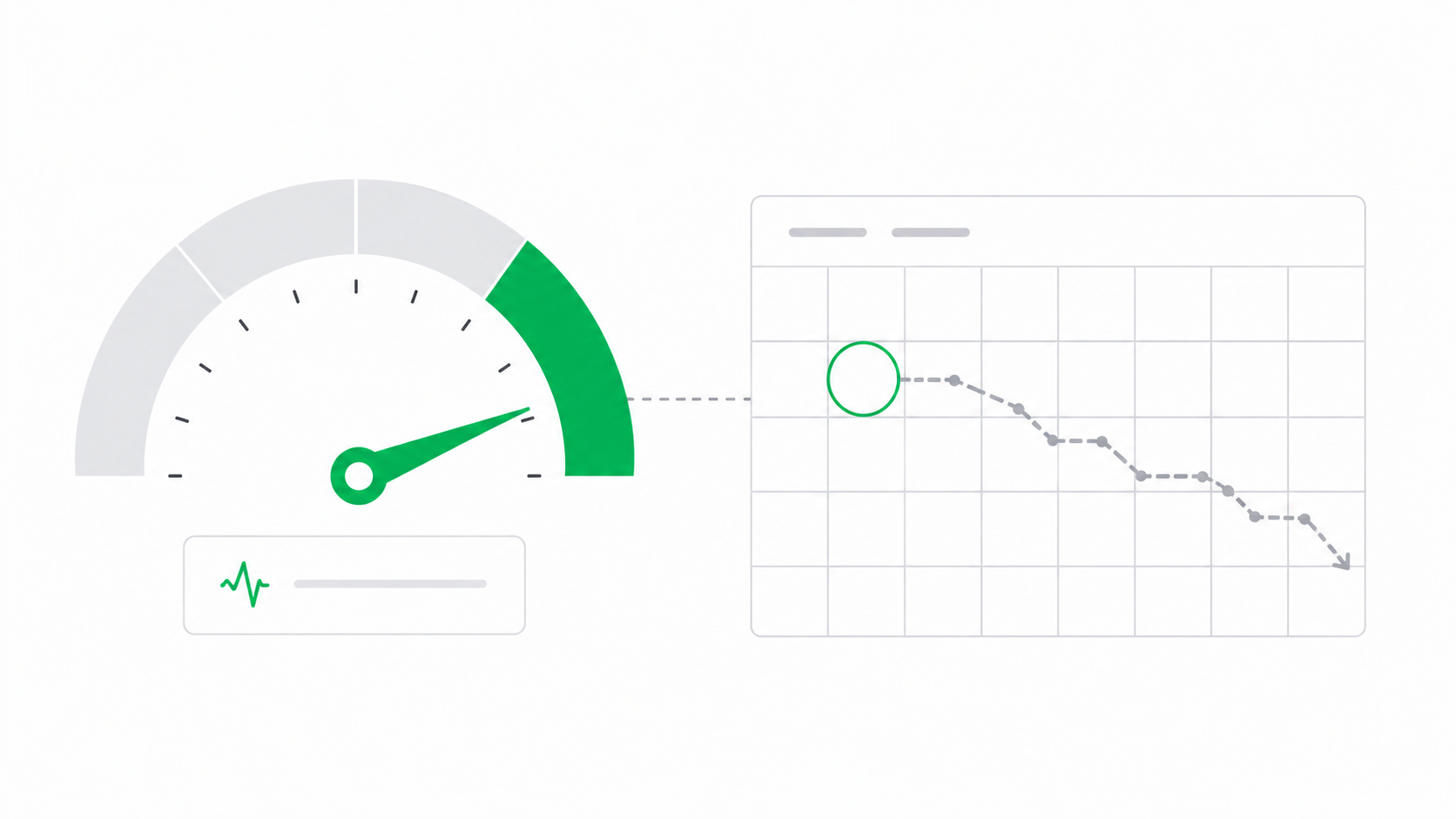
Acme Corp is a 180-person B2B SaaS company. Last October, one of their enterprise accounts went through a reorganisation. The VP of Operations who championed the product left. Her replacement never attended the handover call. Three months later the account did not renew. The health score never went below 74.
This is not a rare story. It is the default outcome when CS teams rely on product usage data to detect risk. The problem is structural: by the time product usage drops, the internal decision to evaluate alternatives has already been made. The churn is not predicted, it is confirmed.
Where the 45-day gap comes from
The churn decision in a B2B SaaS account is rarely made by one person in one meeting. It is made over weeks, across a series of smaller moments: a champion who stops advocating internally, a competitive demo someone books quietly, a new stakeholder who arrives with a preference for a different vendor. None of these events show up in product usage data. All of them precede the eventual cancellation by 30 to 90 days.
The signals that matter earliest are conversational and relational. A champion who used to respond within the hour starts taking two days. A stakeholder who attended every QBR for a year quietly misses the last two. A phrase appears in a call transcript, "we are reviewing our vendor stack", and nobody flags it because nobody is reading every transcript every week across 60 accounts.
Laid out on a timeline, the pattern is remarkably consistent across accounts that eventually churn. In the first one to two weeks, a champion's response time quietly doubles or triples, not enough to trigger any alert, just enough that a person tracking the relationship closely would notice. Around week three to four, a competitive evaluation typically starts, visible only in scraps: a calendar hold with a vague title, a transcript mention of "comparing options." By week six to eight, an internal budget conversation is usually already underway on the customer's side, discussed in meetings the CS team was never in the room for. None of this shows up as a login drop. The product usage stays flat, sometimes it even ticks up, because the team using the tool day to day is often the last to know a decision is being made above them.
What health scores actually measure
Health scores are built on product usage data: login frequency, feature adoption, session length, ticket volume. These are all lagging indicators. They measure what a customer has already done, not what they are about to decide.
A customer who has decided to leave does not stop using the product immediately. They continue using it while they evaluate alternatives, while they negotiate with a new vendor, while they build the internal case for switching. The usage data stays stable for weeks after the decision is made. The health score stays green. The CSM has no idea.
This is not a flaw in any particular health score formula, it is a structural limit of what the inputs can see. A score built from logins, feature adoption, session length, and ticket volume is measuring behavior, and behavior lags intent by design, because a customer keeps behaving normally right up until the day they don't. An account can be logging in daily, adopting a new feature, and closing tickets on schedule, while the person who actually controls the renewal decision has already sat through a competitor's demo. The score has nothing to disagree with. It was never built to see the meeting that isn't in the product at all.
"Accurate predictions and concise, actionable explanations of churn risk saving my team 2+ hours daily. I love that it reflects the right reasons accounts are at risk without us handcrafting a health score."
Wendy Zingher, VP of Customer Success · LambdaTest
What 45 days earlier buys you
A 45-day window changes what interventions are available. At 45 days, you can have a strategic conversation. You can get to the new stakeholder before they form a negative opinion. You can surface the value the product has delivered in a way that lands with the economic buyer rather than just the champion. You can identify and address the gap that is driving the evaluation, and you can do it with enough runway that the fix, not just the promise of one, is what the customer sees before they decide anything.
At 7 days, your options are a discount or a plea. Neither is a recovery strategy. Both damage the relationship even when they work, because both signal that the only reason the customer is being taken seriously is that they were about to leave. A save that happens at 7 days also tends not to stick, the underlying reason for the evaluation was never actually addressed, it was just paid over for one more renewal cycle, and the same conversation resurfaces the following year with less patience on both sides.
Why most teams still miss it
The gap is not awareness. CS leaders know that early signals exist. The gap is coverage. A CSM managing 60 accounts cannot read every call transcript, track every stakeholder engagement pattern, and monitor org changes across every account every week. They read the ones that surface through manual review, which is the top ten accounts by MRR and the ones that sent a complaint recently.
The other 50 accounts get a periodic check-in and a health score glance. The accounts that churn quietly are almost always in that group.
The math does not work no matter how the week gets organized. A CSM covering 60 accounts on a five-day week has, generously, a couple of hours a week of genuinely unscheduled attention to spread across every account beyond the ones already flagged. That is not enough time to skim a transcript for every call, let alone read one closely enough to catch a single hedging phrase buried in forty minutes of otherwise routine conversation. The accounts that get read closely are the ones already making noise. The accounts that churn quietly are, by definition, the ones that never made any.
RetainSure reads every transcript and tracks every stakeholder, across your whole book, every day.
The signals that precede churn by 45 days surface automatically. The CSM decides what to do, not whether to look.
What to look for in a churn detection tool
The test is whether the system reads what customers say, not just what they do. A tool that builds predictions from product usage data alone will always be working with lagging indicators. A tool that reads call transcripts, tracks stakeholder engagement over time, and monitors org changes is working with the signals that precede the behaviour change.
- Does it process call and email transcripts, or only product usage data?
- Does it track individual stakeholder engagement, or just aggregate account health?
- Does it explain why an account is flagged with enough specificity to act on?
- Does it surface what to do next, or just that something is wrong?
The fourth question is the one most tools fail on. Knowing an account is at risk is not useful if the system cannot tell you whether the issue is a disengaged champion, a missed value milestone, or a competitive evaluation that started in November. Each of those requires a different response. A risk score without context sends the CSM into a conversation without a map.
How to find your own 45-day window this week
Before buying anything, it is worth calibrating what "45 days early" actually means for your own book, because the number is an average, not a guarantee for any single account. Pull the last five accounts that churned unexpectedly, the ones the health score never flagged, and go back through every transcript, call note, and email thread on file for each one. Somewhere in that record is almost always the earliest real signal, a hedge in a call, a stakeholder who stopped showing up, a phrase that in hindsight was the tell. Mark the date it appears and count backward from the cancellation date.
That exercise does two things at once. It shows the team what an early signal actually looks like in your specific product and customer base, which is usually more concrete and more findable than "watch for risk" ever is in the abstract. And it gives an honest answer to whether the gap between signal and health-score movement is closer to 45 days or closer to 10, which changes how urgently the coverage problem needs solving.