
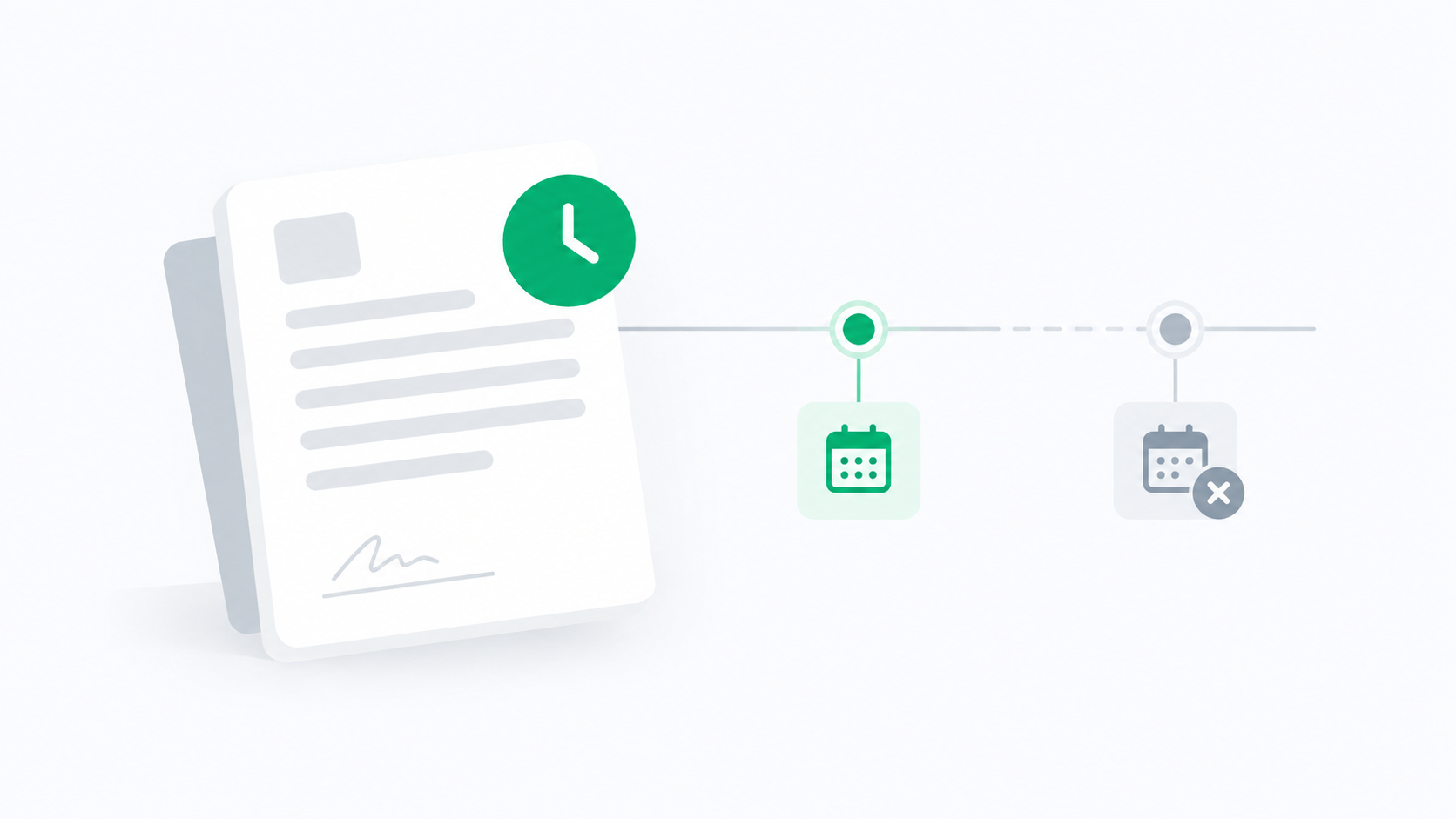
Acme Corp's CS team treated an auto-renewal clause the way most teams do, as a quiet convenience that saved everyone the hassle of a formal renewal conversation. On one particular account, that convenience became the whole story: the customer had been dissatisfied for months, had already started evaluating a competitor, and fully intended to give notice before the contract renewed. Nobody at Acme Corp flagged the account as at risk in time, and nobody at the customer's side caught the opt-out window before it closed. The contract auto-renewed for another year, and the account spent that entire year as a captive, resentful customer instead of either a saved relationship or an honest loss.
An auto-renewal clause is not neutral. It's a mechanism that locks in an outcome by default, and whether that default works for or against the relationship depends entirely on whether anyone is actually watching the window it creates.
Why auto-renewal clauses cut both ways
The appeal of auto-renewal is real: it removes friction from renewals that would have sailed through anyway, saving both sides a formal negotiation for a relationship that isn't actually in question. For a genuinely healthy account, that's a clean, low-friction win, exactly what the clause was designed to do.
The same mechanism becomes a liability the moment the account isn't healthy, because it removes the natural moment where dissatisfaction would normally surface and get addressed. A customer who's unhappy but hasn't yet formally acted gets locked into another term by default, not because the relationship improved, but because nobody on either side moved fast enough inside a window that most people don't even track closely.
What actually determines whether the clause helps or hurts
Two things decide the outcome: whether the account is genuinely healthy going into the window, and whether anyone is actually watching the opt-out date closely enough to act on it either way. A healthy account with a tracked window sails through cleanly, exactly as designed. An at-risk account with an untracked window becomes either a trapped customer who churns loudly at the next opportunity, or, less often, a customer that quietly slips out through the opt-out clause before anyone on the vendor side ran the kind of forecast that would have caught the risk.
Auto-renewal doesn't create risk on its own. It removes the natural forcing function that would otherwise have surfaced a problem, the same structural gap a multi-year contract creates for a much longer stretch of unmonitored time.
Three mistakes teams make with auto-renewal clauses
Each of these treats the clause as something to set and forget rather than a window that needs active management.
Not tracking the opt-out window at all
Most CS teams can quote a contract's renewal date from memory but have no idea when the opt-out deadline for that same contract actually falls, often thirty, sixty, or ninety days earlier. Without that date tracked separately, the window closes without anyone on either side making an active decision about it.
Treating every auto-renewal as a safe default
Assuming an account will auto-renew cleanly because it always has before ignores the fact that account health changes, sometimes quickly, and a clause that worked fine for three consecutive terms can trap an increasingly unhappy customer on the fourth if nobody's checking health specifically before each window closes.
Not flagging at-risk accounts before their window closes
An account already showing churn signals deserves a real, proactive conversation before its opt-out window shuts, not silence that ends in an auto-renewal neither side actually wanted. Letting the clause make the decision by default, on an account already known to be shaky, converts a manageable risk into a guaranteed bad outcome for someone.
"Accurate predictions and concise, actionable explanations of churn risk saving my team 2+ hours daily. I love that it reflects the right reasons accounts are at risk without us handcrafting a health score."
Wendy Zingher, VP of Customer Success · LambdaTest
What managing auto-renewal risk actually looks like
The fix starts with tracking the opt-out date as its own field, separate from the renewal date, for every contract that carries one. That single piece of information, captured once, turns an invisible deadline into a visible one on the same calendar a CS team already watches for renewals.
Layered on top of that, every account approaching its opt-out window gets a genuine health check first, not a default pass-through. A healthy account clears the check and renews as designed. An account showing real risk gets a proactive conversation before the window closes, giving both sides an honest chance to address the problem instead of letting a clause make the decision neither one actually wanted.
RetainSure tracks opt-out windows separately from renewal dates, flagged against real account health.
So an at-risk account never auto-renews by default, and a healthy one never gets an unnecessary interruption.
How to check whether your own book is exposed to this risk
Pull every contract with an auto-renewal clause and check two things for each: whether the opt-out date is actually tracked anywhere separate from the renewal date, and what the account's current health actually looks like heading into that window. Any account that's both untracked and showing risk signals is carrying exactly the exposure this post describes, whether or not it's ever surfaced as a problem yet.
For every gap the audit finds, the fix is simple and permanent: add the opt-out date as a tracked field going forward, and build a health check into the process before that date arrives on any future contract. The work only needs doing once per contract to close the gap for its entire remaining life.
Acme Corp added opt-out tracking to every contract the quarter after the trapped account finally churned at the next available window, a full year later than it should have. Three other accounts came back flagged as approaching their window with real risk signals attached. Two got saved with a direct conversation before the deadline. One churned honestly, on schedule, instead of trapped for another year first.