
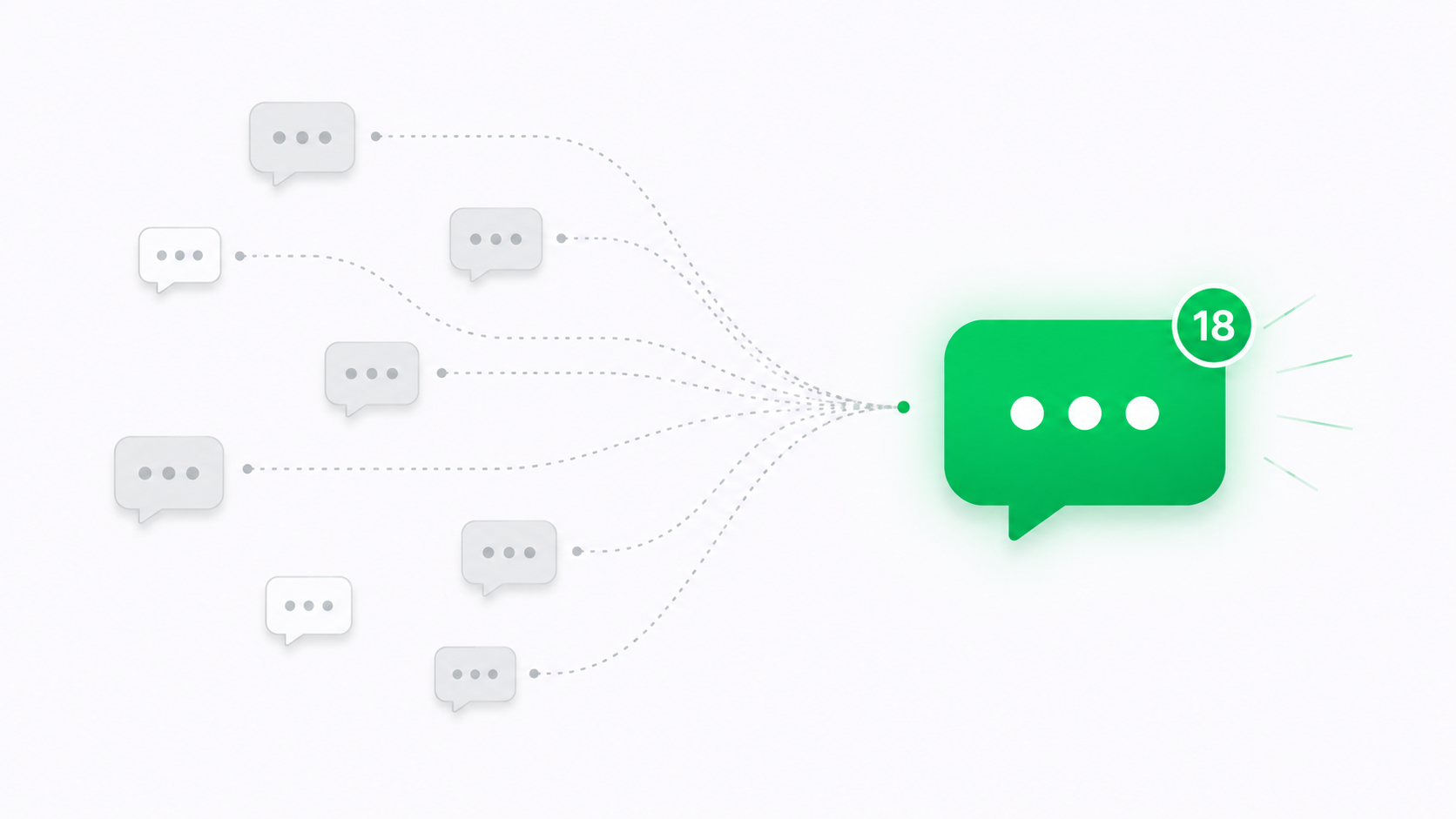
Acme Corp's CS team had been mentioning the same missing integration in Slack messages to the product channel for eight months. Individually, each message read like a minor, one-off request, easy to skim past on a busy day. Product had no real sense it was costing renewals until an account said so explicitly in an exit interview. Someone went back and searched the product channel afterward and found eleven separate mentions from CS over those eight months, never once aggregated, never prioritized, each one read in isolation by whoever happened to be online that day.
The information had been there the entire time. It just never crossed the line from individual anecdote to visible pattern, and that line turns out to be the entire job of a CS-to-product feedback loop. Getting customer signal in front of product is not the hard part. Getting it there in a form product can actually act on is.
Why the CS-to-product feedback loop usually breaks
CS is closer to customer pain than almost anyone else in the company, and that proximity is exactly what makes the reporting so inconsistent. Feedback arrives whenever a CSM happens to think of it, in whatever channel is closest at hand, Slack, a hallway conversation, a comment buried in a QBR recap nobody rereads. None of that is aggregated anywhere, so product only ever sees whichever single request happens to reach the right person on the right day, not the pattern sitting quietly across twenty accounts saying some version of the same thing.
The loud, single account that escalates hard gets a response. The pattern that fifteen quieter accounts are all independently running into, never phrased urgently enough to trigger anything, gets ignored, even when it is worth far more in aggregate revenue than the one account making noise.
What CS should actually report, and how
The first thing worth reporting is frequency-weighted patterns, not individual complaints. One account asking for a feature is an anecdote. Fifteen accounts independently asking for the same thing is a pattern, and product needs to see it presented as fifteen, not as fifteen separate messages that never got counted against each other.
The second is dollar impact, attached directly to the request. Which accounts are affected, how much ARR they represent, and whether the gap is putting retention at risk or actively blocking an expansion that's otherwise ready to close. A request with a number next to it competes for product's attention on the same terms as every other roadmap item they're weighing. A request without one reads as a nice-to-have by default, regardless of how much revenue is quietly riding on it.
The third is cadence. Reporting on a fixed schedule, monthly is typical, turns CS feedback into a source product can plan around, instead of a stream of interruptions competing with everything else in their day. A monthly digest gets read the way a report gets read. A constant trickle of one-off Slack pings gets treated the way notifications get treated, which is to say, mostly ignored once the volume passes a certain point, the same discipline that makes a structured handoff outperform an open notes field for the same underlying reason.
The mistake that causes the most damage
Reporting every complaint as if it's equally urgent
Treating a single frustrated account's message with the same urgency as a genuine pattern trains product to tune out CS feedback altogether, because most of what arrives turns out not to be as urgent as it was framed. The account that escalates loudest gets prioritized over the pattern quietly affecting more revenue, simply because it was louder, not because it mattered more.
Sending feedback only when someone happens to remember
Feedback that shows up on no predictable schedule gets treated as noise rather than a source, no matter how good any individual piece of it is. Product cannot plan around information that might arrive today or might not arrive again for two months, so they stop weighting it heavily in planning at all.
Never closing the loop back to CS on what happened to a request
When CS reports a pattern and never hears anything back, built, rejected, deprioritized, whatever the outcome, they have no way to know whether reporting is worth the effort. The team quietly stops bothering, the same pattern keeps recurring in customer conversations, and the one channel that could have caught it earlier goes silent, not because CS stopped noticing, but because nobody ever told them noticing mattered.
"RetainSure helped Mailmodo's CS team crack upsell at scale. By zeroing in on high-potential self-serve accounts and providing personalised email drafts, the team saw a 20x ROI from their very first month on the platform."
Sanjana Shankar, Head of Customer Success · Mailmodo
What a realistic feedback loop actually looks like
A monthly digest, not a stream of individual messages, ranks every recurring request by how many accounts raised it and how much ARR sits behind it. Each item carries a number, not just a description, so product can weigh it against everything else competing for the same roadmap slot. And every item gets a status update the following cycle, built, planned, or explicitly declined, so CS knows the loop is actually closing rather than reporting into a void. Getting the dollar figure right on each item leans on the same discipline behind measuring ROI anywhere else in the business: a number that survives someone asking where it came from.
How to build the aggregation habit without buying new tooling
This does not require a new system, it requires a consistent label, the kind of small, cheap discipline that tends to be worth building by hand before reaching for a tool to automate the mechanical part of it later. Every time a CSM hears a product request during a call, a ticket, or a QBR, it gets tagged with a single consistent term in whatever notes or CRM system the team already uses, at the moment it happens, not reconstructed from memory later when someone finally sits down to write the monthly report. Reconstruction from memory is where most of the signal quietly gets lost, because the request that felt minor in the moment is exactly the one nobody remembers by the time the digest gets written.
Once a month, someone pulls everything tagged, groups it by what's actually the same underlying request phrased differently, counts the accounts and adds up the ARR behind each group, and sends the ranked list to product. The whole exercise takes under an hour once the tagging habit is in place, and it turns eight months of scattered Slack messages into a single, rankable list product can actually act on.
RetainSure surfaces the pattern across every account, automatically.
Recurring requests and their combined ARR impact, aggregated from account activity your team is already logging.
Acme Corp's next product sync opened with a ranked list instead of a scattered memory of Slack messages. The missing integration sat at the top, eleven accounts, a specific ARR figure attached, and a request that had been quietly repeating for eight months finally read as exactly what it was: a pattern, not a complaint.