
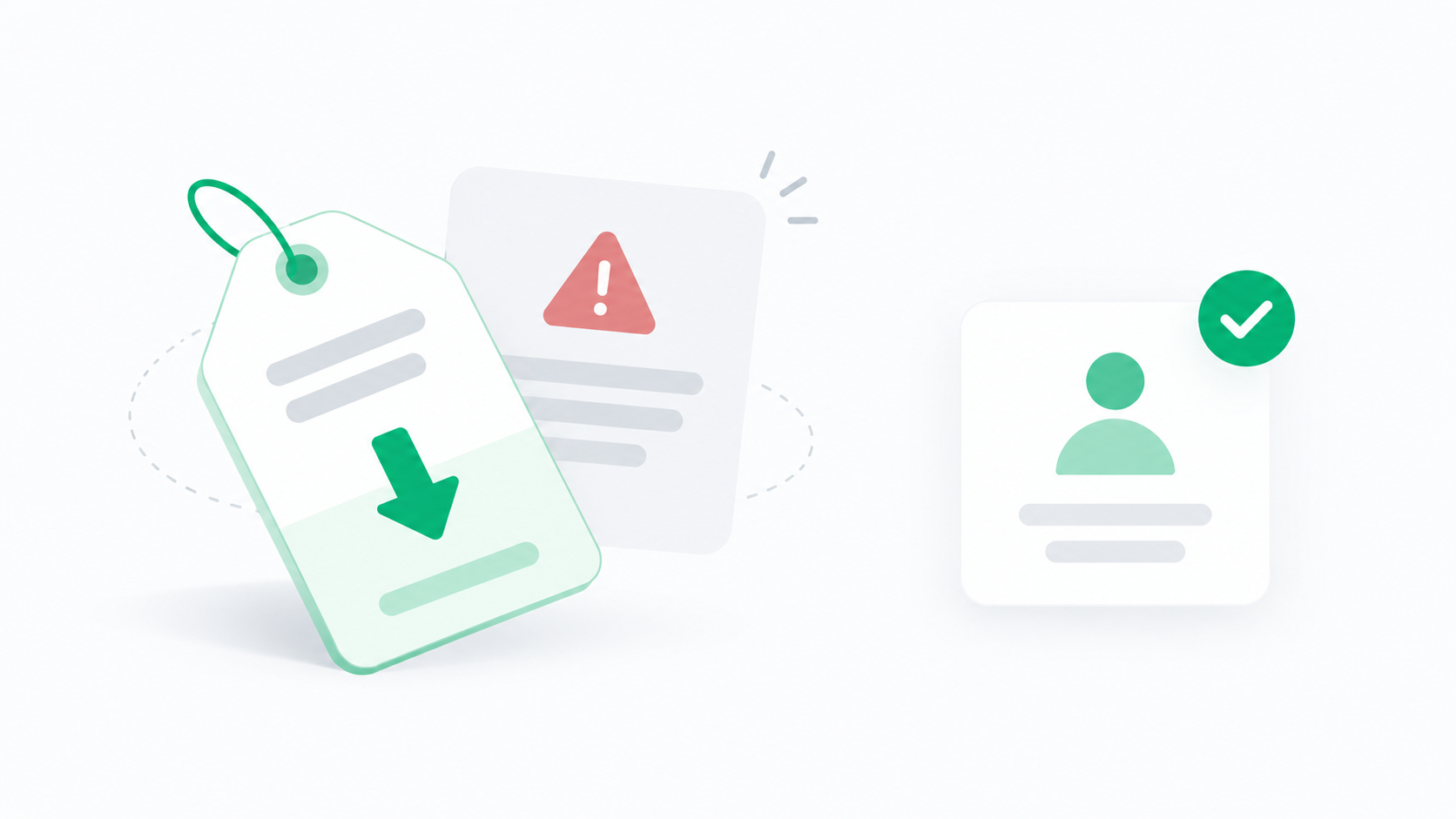
Acme Corp's CSM had a renewal in trouble: the champion said budget was tight, a competitor had quoted lower, and the contract date was eleven days out. A fifteen percent discount closed it the same afternoon, and it went into the quarter's numbers as a save. Nine months later the account churned anyway. The discount hadn't touched the reason the account was unhappy, which was a feature gap nobody had raised. It had only made the eventual loss slower, and taught the customer that the price on the page was an opening bid.
A discount is a tool with one specific job, and used for the wrong job it costs margin without buying retention. Telling the two situations apart is the whole skill.
Why a discount feels like a save even when it isn't
A discount produces an immediate, visible result: the renewal closes, the number goes green, the pressure lifts. That speed is exactly why it's the default move under deadline. But closing the renewal and fixing the reason the account was at risk are two different outcomes, and a discount only ever delivers the first one.
When the real driver is price, a discount genuinely resolves it. When the real driver is anything else, a missing capability, a cold relationship, a champion who left, the discount is a transfer of margin to the customer with nothing changed underneath. The renewal closes and the risk stays exactly where it was, now with a lower revenue line attached.
The one question that separates a real price problem from a proxy
Price is the most socially acceptable objection a customer can raise, which is why it so often stands in for something harder to say. "Budget is tight" can mean exactly that, or it can mean the product isn't delivering enough value to defend in a budget review. The two look identical on a call and need opposite responses.
The separating question is direct: if the price were lower, would the concern go away, or is there something else that would still need to change? A customer whose answer is a clear yes has a real price problem. One who hesitates, or names a second issue, is telling you the discount alone won't hold, the same way a downgrade request needs the underlying reason asked before anything gets agreed.
Three mistakes teams make discounting at renewal
Each of these spends margin without buying anything durable.
Discounting before diagnosing
Offering the discount as the opening move, before asking what's actually driving the hesitation, skips the only step that tells you whether it will work. It also anchors the whole conversation on price, which makes every other concern harder to surface afterward.
Giving the discount for nothing in return
A discount with no exchange attached teaches the customer that price is negotiable on demand. The same concession tied to a longer term, a case study, an expanded seat count, or an earlier signature turns a giveaway into a trade, and it's far easier to defend internally.
Never tracking what the discount actually bought
Most teams log the discount and the renewal but never revisit whether that account renewed cleanly the next cycle. Without that follow-up, there's no way to learn which discounts saved accounts and which only postponed a loss, so the same low-yield discounts keep getting offered.
"RetainSure helped Mailmodo's CS team crack upsell at scale. By zeroing in on high-potential self-serve accounts and providing personalised email drafts, the team saw a 20x ROI from their very first month on the platform."
Sanjana Shankar, Head of Customer Success · Mailmodo
What a discount policy that works actually looks like
The policy starts with a rule that the diagnostic question comes first. A discount is only on the table once the objection has been confirmed as price, and even then it arrives with a condition: a multi-year commitment, an expansion, a reference. That keeps the concession tied to something the business actually gets back.
It also sets a ceiling and an owner. A defined maximum, and a named person who can approve anything above it, stops the discount from becoming whatever the CSM felt pressured into on a Friday afternoon. Tracking every discounted account through its next renewal closes the loop, so the team sees which concessions held, the same discipline behind an honest renewal forecast.
RetainSure separates price-driven risk from risk a discount can't fix.
So concessions go to the accounts they'll actually save, not the ones they'll only delay.
How to audit your own discount history for what it really bought
Pull every renewal discounted in the last four quarters and record two things for each: whether a price objection was actually documented at the time, and whether the account renewed at or above its discounted rate the following cycle. Most teams running this audit for the first time find a large share of discounts went to accounts where price was never the stated issue.
Sort the results into discounts that held and discounts that only delayed. The delayed pile is the money spent on nothing durable, and the pattern in it, usually a missing capability or a cold relationship, points at what should have been fixed instead of priced around.
Acme Corp ran that audit and found nineteen of thirty discounts had no documented price objection. Eleven of those accounts had already churned or downgraded. The next quarter's discounts all followed the diagnostic question and carried a condition. Fewer went out, and the ones that did held through the following renewal, because each one had been aimed at a problem it could actually solve.