
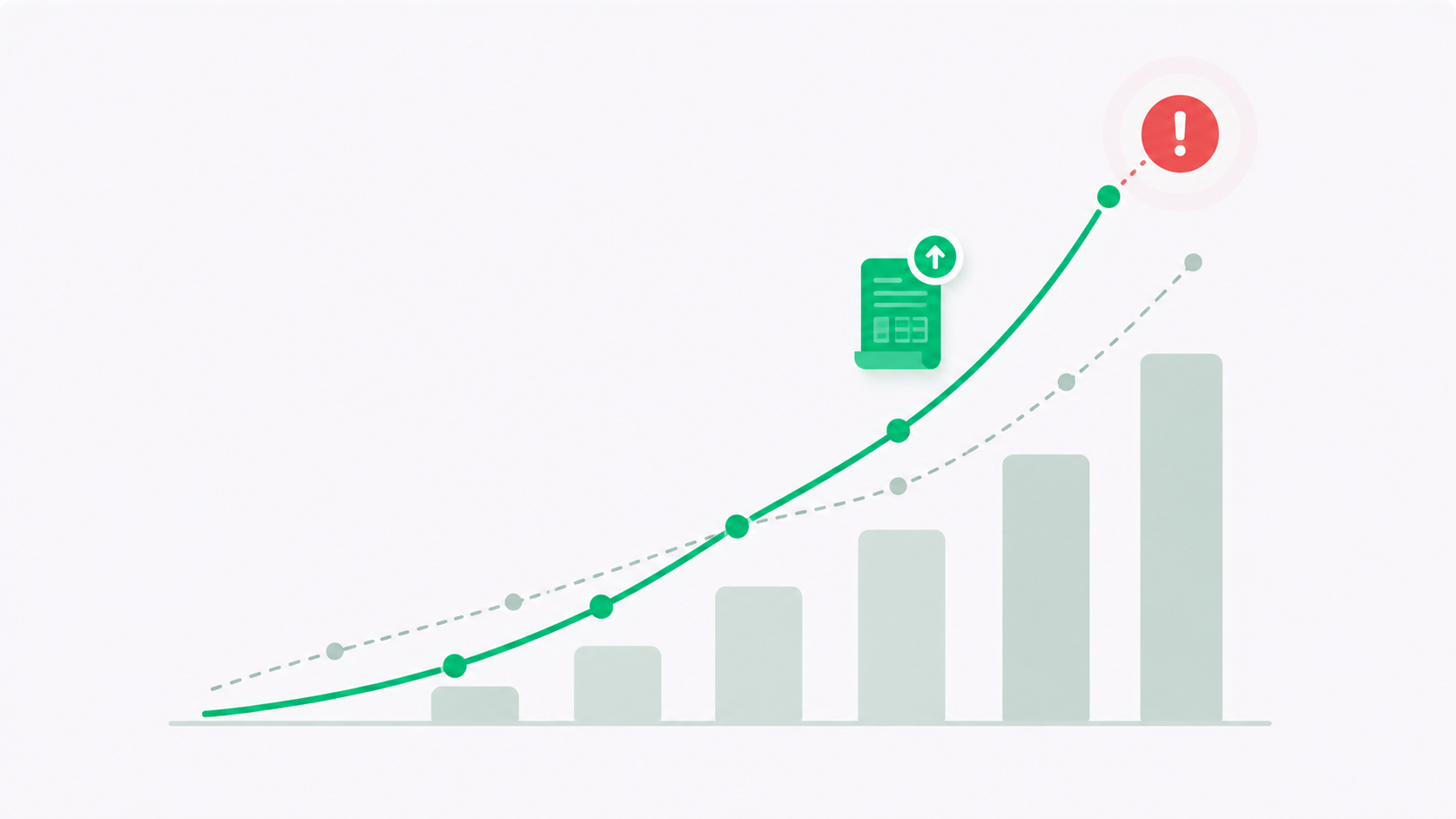
Acme Corp's health score had flagged the account green for six straight months. Usage climbing steadily, feature adoption broadening, every signal a CSM is trained to read as a renewal that takes care of itself. Then the invoice landed, three times the size of the account's usual bill, and the champion's first message wasn't a thank-you for the growth. It was a threat to downgrade the whole contract before the next billing cycle.
Nothing about the account's actual relationship with the product had gone wrong. What went wrong was that the health score was still reading usage the way it would have under the old flat-fee contract, as an unambiguous sign of health, when under a usage-based one, more usage now meant a bigger bill, and a bigger bill without warning is its own churn risk, independent of whether the customer is happy with the product.
Why "more usage is good" stops being reliably true
Under a flat-fee subscription, usage and cost are unrelated. A customer can double their usage and pay exactly the same amount, so rising usage really is close to a pure health signal, evidence the product is becoming more embedded in how the team works. Usage-based and hybrid pricing breaks that relationship on purpose, tying cost directly to consumption, which means usage is now also a proxy for the customer's next invoice. A CS team that keeps reading usage the old way is tracking half of what actually determines whether the account renews.
The two failure modes this produces are opposite of each other, which is what makes them easy to miss. An account can look at-risk on a traditional health score because usage dipped, when the dip is just a quiet month with no relationship to churn risk at all. Or an account can look perfectly healthy because usage is climbing, while the customer is quietly panicking about where their bill is headed, a risk the health score has no way to see because it was never built to track cost.
The two failure modes unique to usage-based accounts
Bill shock is the more dangerous of the two, because it hits exactly the accounts a traditional health score would flag as the team's best. A champion who's expanded usage without anyone flagging the cost trajectory to them is not being difficult when the invoice lands and they push back, they're reacting to a number nobody prepared them for, on a relationship the CS team assumed needed no attention because the usage graph looked great.
The quiet-month false alarm runs the other direction and burns CSM attention instead of risking revenue directly. A usage dip that's actually a seasonal lull, a project wrapping up, or a single power user going on leave, reads identically to early churn risk on a score built for flat-fee accounts. A CSM chasing every usage dip with a "checking in, everything okay?" email on an account that was never at risk trains the account to tune out exactly the outreach that matters when a real risk eventually does show up.
Three mistakes teams make treating usage-based accounts like flat-fee ones
Each of these comes from carrying a flat-fee mental model into a pricing structure it was never built for.
Treating any usage increase as pure good news
Under usage-based pricing, growth without a cost conversation is a liability waiting to surface at invoice time, not a milestone to celebrate quietly and move on from. An account whose usage doubled without anyone proactively discussing what that means for the bill is an account walking toward a surprise, not a team scoring a quiet win.
Treating any usage dip as churn risk
Reflexively escalating every usage decline burns goodwill on accounts that were never at risk and, worse, trains the team to associate usage-based accounts with constant false alarms, which is exactly the environment where a real signal gets ignored because it looks like all the others.
Not tracking the invoice-to-budget ratio at all
Most CS teams can quote an account's usage trend from memory. Very few can say, for the same account, how this month's projected invoice compares to what the customer actually budgeted for the product, a gap that a traditional account review rarely surfaces on its own. That second number is the one that predicts a downgrade call, and it's the one that almost never appears on a traditional dashboard built around usage and health scores alone.
"Accurate predictions and concise, actionable explanations of churn risk saving my team 2+ hours daily. I love that it reflects the right reasons accounts are at risk without us handcrafting a health score."
Wendy Zingher, VP of Customer Success · LambdaTest
What CS actually needs to watch instead
The fix isn't abandoning usage as a signal, it's pairing it with the cost trajectory it now implies. Two numbers matter more than usage alone: the trend of the projected invoice relative to the account's known or estimated budget, and the rate of change in that trajectory, since a usage curve accelerating faster than the account has been warned about is the actual precursor to a bill-shock conversation, not the usage number by itself.
Both of those numbers are things a CS team can proactively surface before the invoice ever lands, which turns bill shock into a scheduled conversation instead of an inbound complaint. An account trending toward a 2x invoice increase deserves a heads-up call in week two of that trend, not a defensive one after the invoice triggers a downgrade request, and the same metrics discipline that predicts renewal risk on a flat-fee account works here, once cost is added as an input alongside usage.
RetainSure tracks the invoice trend, not just the usage curve.
Flags accounts heading toward bill shock before the invoice lands, not after the downgrade request.
How to build the bill-shock alert this month
This doesn't require a pricing overhaul or a new BI stack to start. Pull the accounts whose usage-based charges grew the most in the last full billing cycle and check one thing for each: did anyone at Acme Corp proactively flag the trend to the customer before the invoice went out. For most teams doing this for the first time, the honest answer is no across nearly the whole list, which is the actual size of the exposure sitting in the book right now.
From there, the starter version of the alert is a simple threshold, not a model: any account projected to cross a meaningful invoice increase, doubling is a reasonable first cut, in a single cycle gets a CSM touchpoint before the bill lands, framed as a heads-up and a chance to talk through the growth, not an apology. That single habit converts the highest-exposure accounts on a usage-based book from a source of surprise renewal risk into some of the clearest expansion conversations a CSM will have all quarter.
Acme Corp's champion didn't downgrade. The CSM got ahead of the next cycle's invoice with a two-week warning and a plan to right-size a couple of the account's more expensive usage patterns, and the conversation that would have been a defensive save call became, instead, the one that led to a formal upgrade to a higher committed-use tier. The usage graph had been telling the truth the entire time. It just needed the invoice graph sitting next to it before anyone could read what it actually meant.