
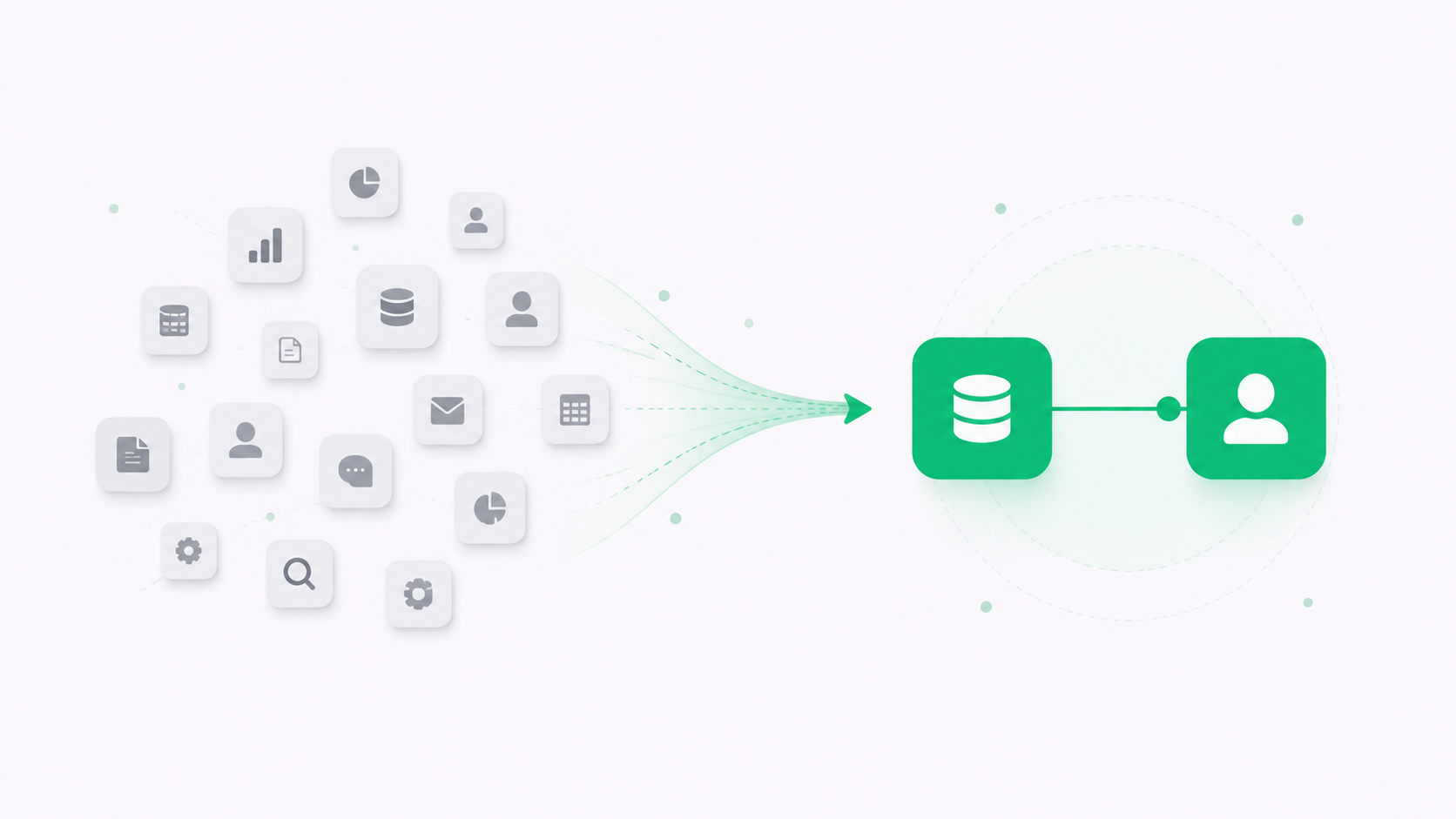
Acme Corp's five-person CS team had six different tools by the start of their second year: a dedicated CS platform, a separate NPS tool, a QBR deck builder, a standalone health-score dashboard, a Slack integration nobody remembered installing, and a spreadsheet the whole team still secretly relied on because none of the actual tools fully agreed with each other. When a new hire asked which system was the real source of truth for account health, nobody could give a confident answer. Three people gave three different tools.
None of those six purchases had been a bad decision in isolation. Each one solved a real, specific problem at the moment it was bought. The stack had grown by accretion, one tool at a time, in response to whatever felt most urgent that quarter, and nobody had ever stepped back to ask whether the whole collection still made sense together.
Why small teams accumulate tools they don't need
Every individual purchase in a growing stack usually has a defensible reason behind it. The NPS tool got bought because a board member asked for an NPS number. The deck builder got bought because QBR prep was eating too many hours that quarter. Each decision, evaluated on its own, looked reasonable. What never happened at any point was a check on whether the existing stack already covered most of what the new tool was being bought to solve.
A five-person team rarely audits its stack as a whole, because there's no natural moment that forces the question. Each tool gets approved individually, usually by whoever felt the specific pain that quarter, and the accumulated cost, in dollars, in integration overhead, in nobody being sure which system owns which data, only becomes visible once someone finally adds it all up.
What actually determines the right stack size
The first principle is that one tool should own account health as the system of record, not have that logic scattered across three dashboards that each tell a slightly different story. When account health can be answered three different ways depending on which tool someone opens, the team doesn't actually have three sources of truth, it has zero, because nobody trusts any single one enough to act on it without cross-checking.
The second is buying for the actual bottleneck, identified the same way a team should identify whether to automate or hire next, not for whichever feature demoed best in a sales call. A tool bought because it solved a vendor's pitch rather than a documented internal bottleneck tends to get used for a month and then quietly abandoned, while the actual bottleneck it was supposed to fix is still sitting there unaddressed.
The third is treating integration cost as a real cost, not a footnote. A tool that doesn't talk to what the team already uses adds coordination overhead, someone has to manually reconcile two systems, or one of them quietly becomes the version nobody trusts, and that overhead frequently exceeds whatever value the tool provides on its own. The same two-question test that decides whether a workflow is worth automating applies here: a tool only earns its place if it removes more coordination burden than it adds.
The mistake that causes the most damage
Buying a point solution for every individual pain point
Each narrow tool solves one specific problem well and creates a new integration gap in the process. A team that keeps patching individual pain points with individual tools ends up with a stack that is, in aggregate, harder to operate than the sum of the problems it was meant to solve, because now someone has to manage the seams between six different systems instead of the original three gaps.
Choosing tools based on what a bigger company uses
An enterprise CS stack is built for the integration capacity and dedicated ops headcount of a much larger team, and copying it wholesale assumes resources a five-person team doesn't have. The tools themselves aren't wrong, they're simply solving for a scale of coordination problem this team doesn't have yet, and adopting them early adds complexity without the org structure needed to manage it.
Never auditing the existing stack before buying the next tool
The single habit that would prevent most stack bloat is asking, before every new purchase, whether something already being paid for already covers 80 percent of the new tool's job. Skipping that question is how a team ends up with six tools solving overlapping problems instead of three tools solving distinct ones.
"RetainSure helped Mailmodo's CS team crack upsell at scale. By zeroing in on high-potential self-serve accounts and providing personalised email drafts, the team saw a 20x ROI from their very first month on the platform."
Sanjana Shankar, Head of Customer Success · Mailmodo
What a realistic minimum viable stack actually looks like
One system of record owns account health, data assembly, and risk scoring, the single place everyone checks first and nobody has to cross-reference against anything else. One communication and workflow layer handles how the team coordinates day to day, wherever that already happens naturally, rather than a new tool nobody remembers to open. Everything else stays a deliberate "not yet" until a real, named bottleneck justifies it, the same discipline that keeps a hiring decision honest rather than reactive.
How to audit your current stack before adding anything else
List every CS-related tool the team currently pays for, then for each one answer two questions honestly: who actually uses it weekly, by name, not by license count, and what job does it do that nothing else in the stack already does. A tool that fails both, nobody's really using it, and something else already covers its job, is a clear candidate to cut. A tool that fails one but not the other is a candidate to consolidate into whatever tool is already doing the overlapping job.
This audit takes an afternoon, not a project, and it should happen before every new tool purchase gets approved, not just once a year as a cleanup exercise. Doing it consistently, as a gate rather than a periodic reckoning, is what actually keeps a lean team's stack lean instead of drifting back to six tools within another year.
RetainSure is built to be the one system of record, not a seventh tool.
Account health, risk scoring, and QBR drafting in one place, so your stack doesn't need to grow to cover the next gap.
Acme Corp's audit took one afternoon and cut the stack from six tools to two. The NPS tool and the standalone health dashboard both failed the test, nobody used them weekly, and everything they did was already covered elsewhere once someone actually checked. The next tool purchase, six months later, followed the same audit first, and for the first time, everyone on the team could answer the new hire's question the same way.