
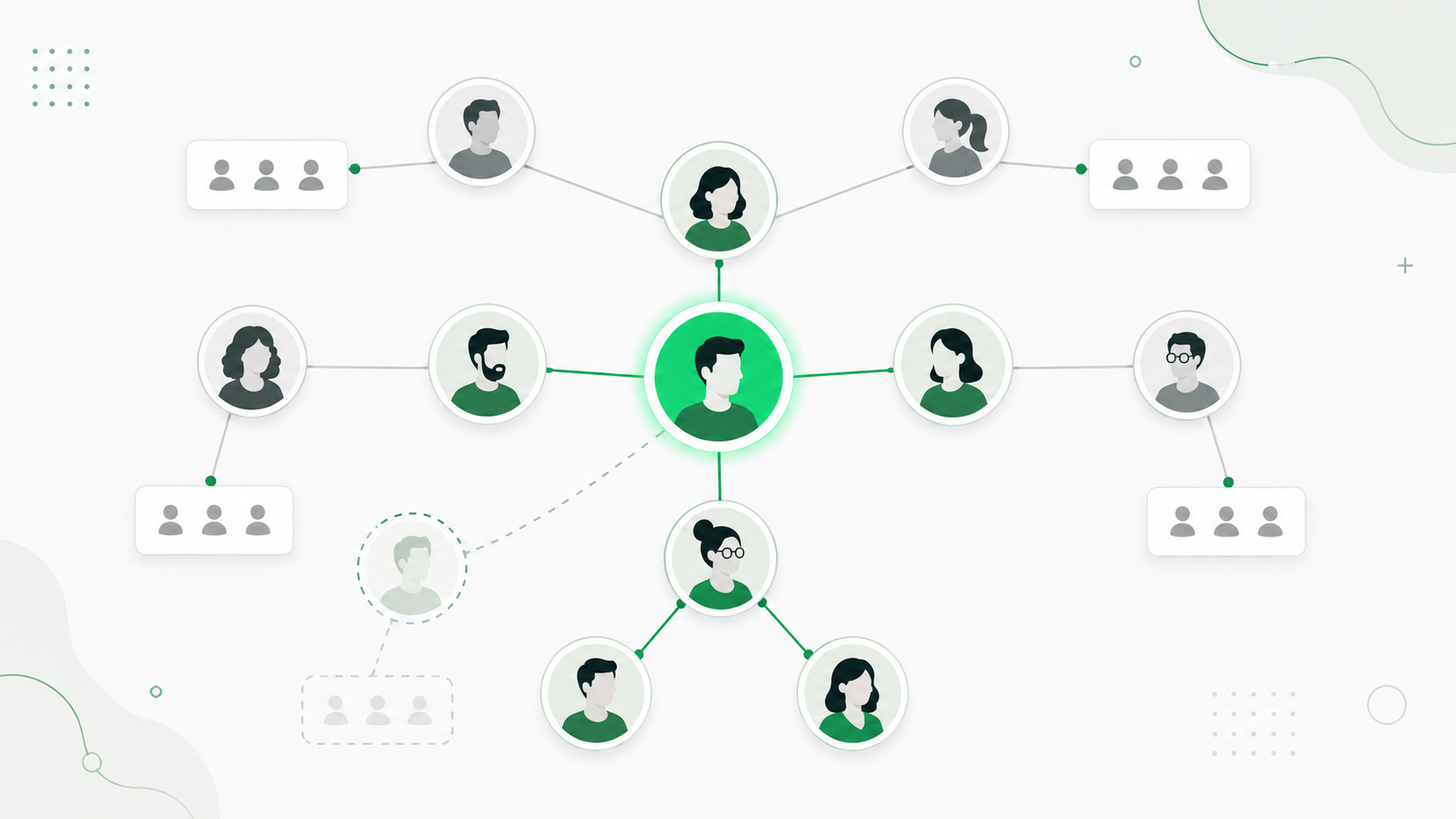
Anna's renewal went sideways for a reason no dashboard flagged. The champion who signed the original deal, the one every account note referenced, left the company four months before the contract came up. Nobody updated the stakeholder field. The health score stayed green because usage held steady, a new team kept logging in. But the internal champion, the person who would have fought to keep the tool, was gone, and the renewal conversation happened with someone who had never advocated for the purchase in the first place.
This is not a usage problem. It is not a ticket problem. It is a relationship problem, and most AI in customer success is built to read data, not relationships. That gap is exactly where stakeholder mapping breaks.
Why stakeholder data goes stale faster than usage data
Usage logs itself. Every login, every feature click, every API call lands in a system automatically, with a timestamp, without anyone having to remember to record it. Stakeholder information does not work that way. Someone has to notice a champion left, notice a new VP joined, notice that the person attending calls now is not the person who signed the contract, and then someone has to go update a field in the CRM. That chain has three points of failure before the data is even wrong, and it usually breaks at the first one: nobody notices in time.
The result is a stakeholder map that is accurate the week it is built and progressively less accurate every week after, with no signal telling anyone it has drifted. A call transcript mentions a new name three times. A CRM field still says the old one. Nothing forces those two facts to reconcile.
Where AI actually helps, and where it still guesses
AI is genuinely useful for one specific part of this problem: noticing that something changed. Reading call transcripts and email threads for new names, title changes, and shifts in who is actually speaking on a customer's behalf is a task AI does well, because it is a text-reading problem, the same kind of problem AI is already solving for churn signal detection. If a transcript mentions three meetings in a row where the original champion is absent and a new name is doing the talking, that is a pattern a model can catch reliably.
Where AI is still guessing, and should be treated as guessing, is org-chart inference: who reports to whom, who has actual budget authority, who is a genuine advocate versus who just attends calls. Those are judgment calls even a CSM who knows the account well gets wrong sometimes. A model inferring seniority from an email signature or a LinkedIn title is working from thin, noisy signal, and treating that inference as fact is how a stakeholder map ends up confidently wrong instead of honestly incomplete.
The mistake that causes the most damage
Treating a stale map as ground truth
The single most expensive failure mode is not missing stakeholder data, it is trusting old stakeholder data without a way to know it is old. A CSM who sees a name in a field assumes it is current, because most systems don't distinguish between "we're 90% confident this is still accurate" and "we entered this once, eleven months ago, and never touched it again." AI should be surfacing that confidence decay, flagging fields that have not been confirmed by a recent signal, rather than presenting every field with equal certainty.
Confusing meeting attendance with influence
The person on every call is not always the person who decides. AI that infers stakeholder importance purely from call frequency will consistently overweight the friendly, available contact and underweight the quiet economic buyer who shows up once a quarter and actually signs the check. This is a case where a CSM's own judgment, informed by AI-surfaced signals rather than replaced by them, still matters more than the model's guess.
"RetainSure helped Mailmodo's CS team crack upsell at scale. By zeroing in on high-potential self-serve accounts and providing personalised email drafts, the team saw a 20x ROI from their very first month on the platform."
Sanjana Shankar, Head of Customer Success · Mailmodo
What a realistic system actually looks like
Not a stakeholder map that claims certainty it does not have. A system that reads calls and emails continuously for name changes and title changes, flags a stakeholder field the moment a signal contradicts it, ages out confidence on fields nobody has confirmed recently, and hands the CSM a clear "this might be stale" flag instead of a silent, outdated name. The CSM still makes the judgment call about who actually matters in the account. The system's job is making sure that judgment is made on current information, not on whatever was true when someone last opened the record.
RetainSure flags stakeholder changes the moment a call or email mentions them.
Confidence-aware stakeholder tracking, not a field that quietly goes stale for months.
Anna's next renewal did not go sideways the same way. Three weeks before the contract came up, a flag appeared: the primary contact on the last two calls did not match the CRM record, and the mismatch had been building for six weeks. She spent an afternoon rebuilding the relationship with the actual decision-maker before the renewal conversation started, not during it. The map was never perfect. It was current, which turned out to be the part that mattered.